
Should I set up a giving fund or donate directly to charity?
“Why would I set up a giving structure rather than give money directly to charity? Aren’t charities losing out?”
This short case study explains how a giving structure – be that a private ancillary fund (PAF) or a giving fund in a public ancillary fund such as the APS Foundation – can help grow your philanthropic dollar, allowing you to give more money to charities over the long term.
Jennifer and Peter (not their real names) had always been generous with giving money to charity but had never considered establishing a giving structure. Then, after a sale of some long-held shares, they started to wonder if a giving structure might make more sense. They were in the fortunate position of having $100,000 to donate but wanted to carefully consider which causes and charities to support over time.
In 2018, Jennifer and Peter set up a giving fund in the APS Foundation and seeded it with $100,000. APS Foundation takes care of the compliance, administration and investment management, meaning Jennifer and Peter can focus on deciding which causes and charities are important to them.
In Australia, people can claim an immediate tax deduction on donations made to a giving fund. They can spread the deduction over up to five years, and have the flexibility to distribute the funds to charity over time. Contributions into a giving fund are irrevocable, with the amount now committed solely for charitable use.
Today, Jennifer and Peter can see how much that decision to establish a giving fund has paid off.
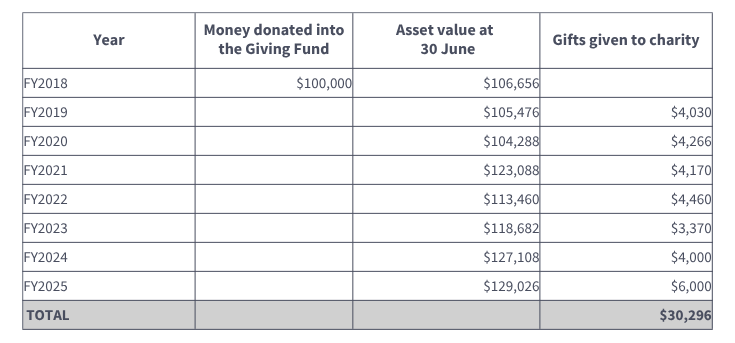
In the eight years since setting up their giving fund, Jennifer and Peter have distributed over $30,000 to charity, and also the giving fund balance at $129,000 is more today than the original donation.
These numbers are based on a real example that experienced the overall market growth experienced by many between 2018 to 2026, as well as the Covid-19 pandemic market shock. These returns may or may not happen again, however what is clear, is the impact that a giving fund can have on the amount donors can give over time, despite market volatility.
How does a giving fund help me give more to charities over time?
What are the benefits of a giving fund?
- Jennifer and Peter originally donated $100,000 to set up their giving fund
- The capital was invested, with the returns accruing to their giving fund
- Every year the couple gifted distributions to the charities of their choice. APS Foundation must give away a minimum of 3% of the preceding year’s closing balance (reverting to 4% from 1 July 2026)
- Jennifer and Peter have not just met, but exceeded the minimum giving amount required in almost all years
- The giving fund is now worth more than the original amount the couple donated into it.
Imagine if Jennifer and Peter had given the full $100,000 directly to charities back in 2018. There is no doubt that the money would have made a significant impact, but they would have lost the opportunity to influence how and where it would be spent over the long term. Furthermore, Jennifer and Peter (with no more windfalls in sight) would have dropped back to lower levels of annual giving. Some charities however find annual donations facilitated by a giving fund are more useful in keeping the lights on for their operations. And receive a regular, ongoing, inflation-adjusted income stream.
Setting up a giving fund gave them time to thoroughly think through their decisions of who to fund, and supported their wish to provide ongoing long-term support to charities rather than large one-off gifts, which can also require careful planning and management by the recipients.
Setting up a giving fund is a win all round. Jennifer and Peter can continue their charitable giving for years to come, and charities will benefit from the ongoing revenue stream far beyond the impact of a one-off donation.
Note: The figures quoted in this case study are based on an actual giving fund in APS Foundation, but names have been changed. It is intended to provide an example only and is not intended to be financial advice. Please make sure you seek financial advice based on your personal circumstances.