
Home Articles The Blueshore Charitable Trust: Investing in good
The Blueshore Charitable Trust: Investing in good
Jon Stretch never set out to become a philanthropist. What he did have was a clear sense that if you have more than you need, you have a responsibility to look around, see what is happening in your own backyard, and do something practical about it. For Jon and his family, establishing The Blueshore Charitable Trust as a family foundation through Australian Philanthropic Services (APS) has turned that instinct into a long-term, structured commitment to investing in good and tackling some of Australia’s most pressing issues.
“If you’ve got plenty, you don’t need to spend it all on yourself”
Much of Jon’s adult life was spent overseas, where social challenges like homelessness could feel distant – an unfortunate reality of another city. Returning to Australia shifted that perspective. Here, homelessness and disadvantage were no longer abstractions; they were on his own streets. “You can just walk by and pretend it doesn’t exist,” he reflects, “or you can find people who are doing something about it and back them.”
That practical, no-nonsense outlook underpins Jon’s approach to giving. He doesn’t see philanthropy as charity in the traditional sense, but as a form of investing – putting capital behind people and organisations he believes can test ideas, learn, and solve problems. Having a structured giving vehicle has allowed him to move beyond one-off donations to a more deliberate, impact focused strategy.
Causes close to home
When the Blueshore Charitable Trust was established in 2017, Jon and his wife Bernadette invited their two adult children and their partners to help define the focus areas. Together, they agreed on two themes that felt both urgent and personal: homelessness, and research into cystic fibrosis, a disease affecting a nephew and cousin in the extended family.
Homelessness appealed to the whole family’s sense of fairness: in a country as prosperous as Australia, chronic homelessness should not be as prevalent as it is. Through a process Jon likens to “startup investing”, the family has intentionally sought out smaller, often lesser-known organisations testing new ways of addressing entrenched problems. A modest initial grant – “a ticket to the dance”, as Jon calls it – gives the trust twelve months to observe how an organisation operates, what it achieves, and whether there is a case for deeper support.
That approach led them to a small LGBTQIA+ housing service in inner Melbourne, which in turn connected them to Launch Housing and its Melbourne Zero initiative. The Melbourne Zero project builds a “byname list” of every person experiencing homelessness in each local government area, then coordinates the efforts of multiple service providers around that real time data, ensuring fewer people slip through the cracks. For Jon, the combination of rich data, clear strategy and measurable progress – tracking individuals through emergency and then permanent housing – made the impact tangible.
Cystic fibrosis was equally personal. The family watched loved ones navigate intense treatment and limited life expectancy and felt compelled to support research that might change that future. When new drugs emerged that dramatically improved life expectancy and quality of life for people with certain strains of the disease, Jon and Bernadette felt they could “quite happily” retire cystic fibrosis as a first order priority and redirect their efforts.
A deeply painful event then reshaped their giving again. At the start of COVID, the son of close friends – a young man the family had known since he was in nappies – died by suicide. The need for help to be available in as many locations as possible led the family to youth mental health as a new, central focus. Through the Danny Frawley Centre and related initiatives, they are now backing programs that build resilience in young people, destigmatise mental health and create clear pathways to clinical support.
Today the trust’s giving revolves around three interlinked themes: homelessness, youth mental health and support for LGBTQIA+ communities, including Transgender Victoria. Each area reflects a convergence of personal experience, strong values and credible organisations able to turn funding into concrete outcomes.
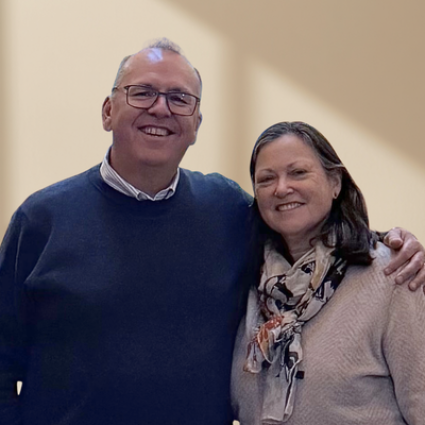
"You can just walk by and pretend these issues don't exist, or you can find people who are doing something about it and back them."
Jon & Bernadette Stretch
A family project, in perpetuity
From the outset, Jon and Bernadette were clear that the Blueshore Charitable Trust would be a family endeavour. The first conversation with their children was frank: some of the capital that might otherwise have formed part of their inheritance would instead be placed in a charitable trust. “If you’ve got objections to that, we’d better talk about it,” Jon told them, but he also presented it as an opportunity to build something enduring together.
The children embraced the idea, not just as beneficiaries of their parents’ generosity but as active participants. Each family member takes responsibility for exploring particular causes or organisations, meeting with leaders, and reporting back to the group. Formal trustee meetings – complete with agendas, minutes and budget discussions – provide structure, but at their heart they are conversations about values: what matters, where the trust can make a distinctive contribution, and how to allocate finite resources in the most effective way.
Over time, those meetings have become a vehicle for broader education. Through the family foundation, the next generation has learned how boards work, what directors’ responsibilities are, and how good governance underpins effective giving. They have also gained exposure to investing, understanding how and why investment targets are set, and how global events and different asset classes affect the portfolio. As Jon notes, it is a powerful grounding for whatever roles they may take on in business, community organisations or other boards in the future.
Perhaps most importantly, the trust has created a shared sense of purpose that Jon can see extending far beyond his own lifetime. His children now envisage a time when they will be leading these discussions with their own children, carrying forward the same commitment to thoughtful, sustained giving.
How APS makes it possible
Jon first came to structured giving via a conversation with his accountant, after a year in which he wanted to give a significant sum. Rather than setting up a private ancillary fund through a large firm at considerable cost, his accountant pointed him to Australian Philanthropic Services. APS specialises in establishing and supporting private ancillary funds and sub-funds in its public ancillary fund, the APS Foundation, simplifying the administration so families can focus on the giving itself.
For Jon, APS has provided the governance backbone that allows the Blueshore Charitable Trust to operate with confidence. APS ensures the family foundation complies with ATO and ancillary fund requirements, that gifts go only to eligible charities, and that reporting and filings are completed accurately and on time. Having a dedicated team means the family can spend their time on identifying impactful organisations, rather than worrying about paperwork.
He also values the way structured giving separates the timing of tax deductions from the timing of grants. In strong income years, the family can make significant, irrevocable contributions into the trust and claim the deduction immediately, while taking the time needed to research and stage their giving over subsequent years. Combined with low administration costs and a supportive investment adviser, Jon sees this as a highly efficient structure: more of every dollar ultimately reaches the organisations on the frontline.
Looking at the growth of structured giving in Australia, Jon hopes that structures like the Blueshore Charitable Trust can positively impact the landscape of philanthropy. For his family, that structure has turned an intuitive desire to “do something” into a disciplined, intergenerational practice of giving that is rigorous, relational and oriented towards lasting impact.